Stop Running Your Service Business From Memory: How I Use Jobber to Stay Organized, Document Jobs, and Grow

If you run a landscaping business, window cleaning company, lawn care company, pressure washing business, or pretty much any home service business, there comes a point where trying to keep everything in your head stops working.
When you're small, you can get away with it.
You remember that Mrs. Johnson needs an estimate on Thursday.
You remember that one customer wanted the bushes trimmed lower.
You remember which employee is supposed to be at which property.
You remember who still owes you money.
Until you don't.
And that's where problems start.
I've been in the service business world for well over a decade, and one of the biggest lessons I've learned is this:
Your memory is not a business management system.
As your business grows, you need a centralized place where your schedule, customers, jobs, notes, photos, quotes, invoices, and communication can actually live.
That's one of the biggest reasons I've continued using Jobber.
Disclosure: I'm a Jobber Ambassador and #JobberPartner. I may earn compensation or other benefits when you sign up through my links. I've also personally used Jobber in my own service business. My goal here is to show you how I actually think about these systems as a contractor and business owner.
You can try Jobber free for 14 days through my exclusive link:

Depending on the current partner promotion available through that link, you may also qualify for a discounted subscription after the trial. Jobber's standard partner terms currently provide eligible referred customers 20% off its then-current pricing for their first six months unless different promotional terms apply.
Jobber
The Bigger Your Business Gets, the More Expensive Disorganization Becomes
A lot of contractors think software is something they need once they become a "big company."
I think that's backwards.
You need systems before the business becomes complicated.
Because once the phone starts ringing, estimates are stacking up, employees are working in the field, customers are texting you, materials need to be picked up, invoices need to go out, and you're trying to actually perform the work too, information starts flying everywhere.
Some stuff is in your phone.
Some stuff is in text messages.
Some stuff is written on paper.
Some stuff is in your head.
And some stuff disappears completely.
That creates what I call mental RAM overload.
You're physically working on one job while mentally trying to remember the next twelve things you have to do.
That isn't freedom.
You're carrying the entire business around inside your nervous system.
A good field service management system gives the business somewhere else to store that information.
That's what software such as Jobber is designed to do.
Jobber lets service businesses manage areas including scheduling, client information, jobs, quotes, invoices, and field operations from one system. Its mobile app also allows you and your team to work from the field.
Next Lesson: Your Schedule Should Tell Your Team What Happens Next
One of the themes I've been talking about recently with Jobber is organization and scheduling.
Your calendar shouldn't just tell you:
"Go to Bob's house at 10:00."
It should become part of your operating system.
Who is going?
What are they doing?
How long should it take?
Where is the job?
What happened last time?
What does the customer expect?
What materials or equipment are needed?
The more of that information your team can access without calling you, the less dependent the company becomes on you.
That's huge.
Because one of the biggest bottlenecks inside a small service business is usually the owner.
Everybody calls the owner.
"Where are we going?"
"What are we doing?"
"What's the address?"
"Did the customer approve this?"
"What did you quote them?"
"What do you want me to do next?"
I've lived this.
If five people need you to answer five questions before they can move, you're not really running a company.
You're running a human router.
The goal is to get the information out of your head and into a system where the right people can find it.
That's one of the things I like about having the schedule and individual job information available from the phone.
Your people can look at where they're supposed to be and what they're supposed to be doing instead of constantly asking you.
And once employees enter the picture, this becomes even more important.
One contractor who watched one of my Jobber walkthrough videos commented that Jobber had dramatically improved his business because he could finally keep track of everything and start thinking about employees.
That's the connection.
Organization creates capacity.
You don't hire people to fix chaos.
You build systems so additional people can operate inside the business without multiplying the chaos
 .
.
Nexr Lesson: If It Isn't Documented, You're Depending on Memory
September's theme is one of the most important operational habits I can teach any contractor:
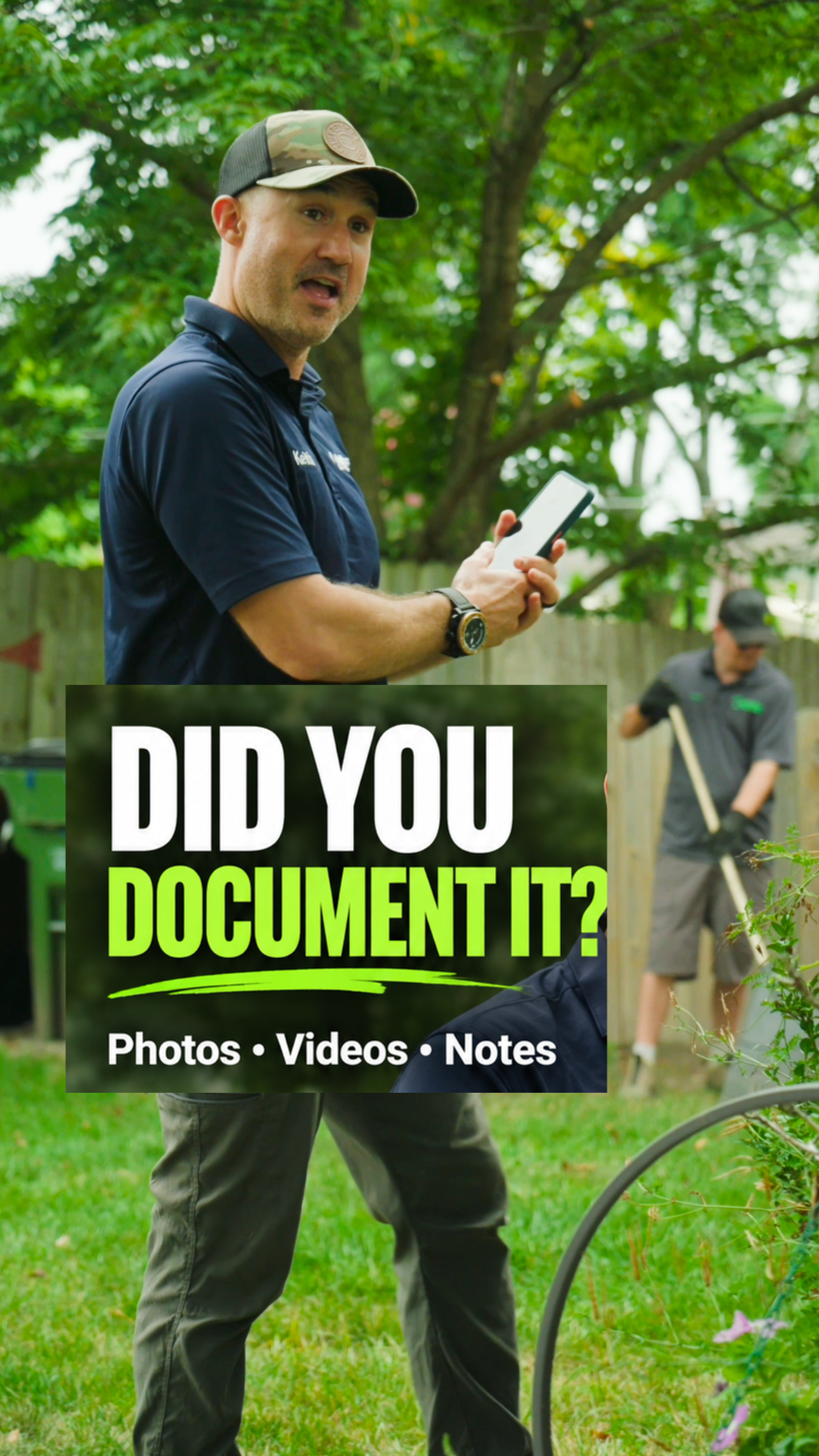
Document the job.
Photos.
Videos.
Notes.
Customer requests.
Changes.
Before pictures.
After pictures.
Anything your team may need later.
Documentation sounds boring until you need it.
Then it's priceless.
Let's say you're trimming shrubs around someone's house.
The customer says:
"Don't touch this hydrangea."
Put it in the job notes.
You notice damage to something before your crew starts working.
Take a picture.
The customer changes part of the scope while you're standing there.
Document it.
You finish a property and want proof of what the job looked like when you left.
Take after photos.
This isn't about becoming paranoid.
It's about becoming professional.
You're creating a history of the job.
Instead of six months later trying to remember:
"Wait… what did we do over there?"
you have a record.
Documentation Also Improves Your Communication
Here's another benefit people overlook.
Documentation helps you communicate with employees.
Imagine an employee arrives at a property and sees a note attached to the job:
"Trim the burning bushes approximately 12 inches below the window."
Or:
"Customer specifically requested that we do not trim the flowering shrub on the right side of the garage."
Now your employee doesn't have to guess.
And you don't have to answer another phone call.
Multiply that by hundreds of jobs.
That's operational leverage.
A service business becomes dramatically easier to manage when the information moves with the job instead of living inside the owner's head.
Take Before-and-After Photos
This is one of the simplest habits you can start immediately.
Before your crew begins, take pictures.
When the work is finished, take pictures again.
You now have documentation.
You also potentially have marketing content.
With the customer's permission and proper privacy considerations, strong project photos can become:
Website images.
Social media content.
Before-and-after posts.
Sales material.
Proof of workmanship.
Training examples for employees.
You did the work once.
But the documentation can continue creating value afterward.
That's a completely different way to look at taking pictures.
Put Notes Where Your Team Can Actually Find Them
Another mistake contractors make is technically documenting information but putting it somewhere useless.
Maybe you texted it to your employee three days ago.
Maybe it's buried inside your notes app.
Maybe you wrote it on a piece of paper sitting inside the truck.
That's not a system.
Information needs to live somewhere predictable.
The advantage of putting notes and information alongside the actual client or job is context.
When someone opens that job, the information they need is attached to the thing they're working on.
That sounds simple.
Simple is good.
Complicated systems don't survive busy season.
The Real Goal Isn't Software
This is important.
Don't buy software because you think software is going to magically fix your business.
It won't.
If your processes are terrible, software can help you perform terrible processes more efficiently.
You still have to think.
You still need pricing discipline.
You still need good communication.
You still need employees who care.
You still need to follow through.
The goal isn't "use software."
The goal is:
Create a business where important information is captured, organized, and accessible without everything having to flow through you.
Jobber happens to be one of the tools I've used to help accomplish that.
I've used it personally in my service business, I've created walkthroughs around it, and I'm also a Jobber Ambassador. Jobber even features our business story on its own site, discussing how using the platform helped organize areas such as quoting and invoicing.
What I Would Do If I Were Starting Over
If I were starting another service business tomorrow, I wouldn't wait until I had five trucks and ten employees before building this stuff.
I'd start immediately.
Every customer goes into the system.
Every legitimate lead gets tracked.
Every job goes onto the schedule.
Important conversations get documented.
Take before pictures.
Take after pictures.
Put instructions where the people performing the work can see them.
Send professional quotes.
Invoice quickly.
Collect money.
Keep improving the process.
Then when you hire employee number one, you already have somewhere for that employee to plug in.
When employee number two comes along, you're not reinventing everything.
That's how businesses become scalable.
Not because you suddenly become some Fortune 500 CEO.
Because the company slowly stops depending on you remembering every single detail.
Don't Build Yourself a Trap
A lot of people start businesses because they want freedom.
Then five years later, they've accidentally constructed a job where they're the salesperson, estimator, scheduler, production manager, customer service department, quality-control department, bill collector, and walking database.
That's not freedom.
And I've been guilty of it too.
The answer isn't necessarily building some gigantic company.
The answer is getting the business under control.
Sometimes the biggest breakthrough isn't another $100,000 in revenue.
It's being able to go home and actually stop thinking about tomorrow's schedule because you know the schedule is already organized.
That's what systems are supposed to give you.
Try Jobber Free for 14 Days
If you run a landscaping company, window cleaning business, lawn care company, pressure washing business, cleaning company, HVAC business, plumbing company, electrical company, or another home service business and you're still piecing everything together manually, take a look at Jobber.
You can try it completely free for 14 days using my exclusive partner link:
No matter what software you ultimately use, start building the habit now:
Schedule it.
Document it.
Put the information where your team can find it.
Stop trying to run your entire business from memory.
Your future self will thank you.
Disclosure: Keith Kalfas is a Jobber Ambassador and #JobberPartner. This article contains an affiliate/partner link, and Keith may receive compensation or other benefits if you sign up or purchase through that link. Experiences described are based on Keith's own use and opinions. Offers and pricing can change. Review the current terms presented when you sign up through the link.