
Are You Building Your Business From Survival Mode?
A lot of people assume that if they’re overwhelmed, constantly behind, easily frustrated, or stuck in cycles of overthinking, the problem must be discipline.
They think they need a better calendar.
A stronger morning routine.
More motivation.
More hustle.
More information.
A better strategy.
A tighter plan.
And sure, sometimes better systems help.
But sometimes that’s not the real issue at all.
Sometimes the real issue is that your body is stuck in survival mode.
That’s a big part of what Keith unpacked inside a recent Untrapped Alliance call — a real conversation about the nervous system, stress, protection patterns, and what it looks like when you’re trying to build a business, lead your life, and make decisions while your body is operating from tension instead of calm.
This one wasn’t about “mindset” in some vague, fluffy sense.
It was more honest than that.
It was about what happens when your body has been carrying stress for so long that tension starts to feel normal. When urgency becomes your baseline. When shallow breathing, racing thoughts, overchecking your phone, or feeling guilty while relaxing become such familiar patterns that you stop questioning them.
And for entrepreneurs, that can be especially tricky.
Because when you’re building something, there’s always more to do.
There’s another call to make.
Another estimate to send.
Another fire to put out.
Another message to answer.
Another responsibility waiting for you.
So it becomes very easy to think the pressure you feel is just part of the game.
But what if some of what you’re calling “drive” is actually stress?
What if some of what feels like ambition is really a body that doesn’t know how to come out of protection mode?
What if you’re trying to build your future while your nervous system is still bracing for impact?
That’s the kind of conversation Keith opened up.
When “Productive” Isn’t Peaceful
One of the things that makes this topic so important is that survival mode doesn’t always look dramatic.
Sometimes it does.
Sometimes it looks like anxiety, panic, frustration, irritability, shutdown, or emotional exhaustion.
But sometimes it looks far more socially acceptable than that.
Sometimes it looks like constantly staying busy.
Always thinking.
Always planning.
Always researching.
Always checking your phone.
Always consuming information.
Always feeling like you should be doing more.
From the outside, that can look like responsibility.
From the inside, it can feel like a nervous system that never really powers down.
A lot of entrepreneurs are functioning like this without even realizing it.
They think they have a time management problem when really their body is running on urgency.
They think they need more discipline when really they’ve been in fight, flight, freeze, or fawn so long that slowing down feels uncomfortable.
They think the answer is learning more, pushing harder, or forcing themselves into better habits — while never addressing the internal state they’re trying to operate from.
That’s what made this Untrapped Alliance call so relevant.
Keith didn’t just talk about success from the outside in. He talked about what’s happening underneath the surface — in the body, in the mind, in the patterns we repeat without realizing it.
The Nervous System Is Trying to Protect You
One of the strongest ideas from the call was simple:
Your nervous system is not your enemy.
It’s trying to protect you.
That matters, because so many people are hard on themselves for the very symptoms that may actually be signs of protection.
Overthinking.
Hypervigilance.
People-pleasing.
Frustration.
Avoidance.
Catastrophizing.
Overworking.
Shutting down.
None of those things feel good.
But when you understand them as patterns of protection instead of proof that something is wrong with you, it changes the conversation.
Instead of only asking, “Why am I like this?” you start asking, “What is my body trying to do for me right now?”
That doesn’t mean those patterns are helping you move forward.
It means there’s something deeper going on than laziness, weakness, or lack of discipline.
And when you start to understand that, you can respond differently.
That’s where this training gets powerful.
Because it’s not just about labeling the problem. It’s about beginning to notice your own patterns with more honesty and less shame.
What Survival Mode Can Look Like in Real Life
This is part of why the session hits so hard.
Survival mode isn’t always obvious.
Sometimes it looks like a tight chest and shallow breathing.
Sometimes it looks like lying in bed tired, but unable to settle down.
Sometimes it looks like replaying stressful situations over and over in your head.
Sometimes it looks like imagining the worst-case scenario before anything bad has even happened.
Sometimes it looks like being unable to truly rest because relaxing makes you feel guilty.
Sometimes it looks like doom scrolling, information overload, or constantly checking for threats in your environment.
And sometimes it looks like trying to keep everybody else happy because conflict feels too expensive.
In other words, survival mode can wear a lot of different faces.
That’s one reason the workbook that accompanies this session is so helpful.
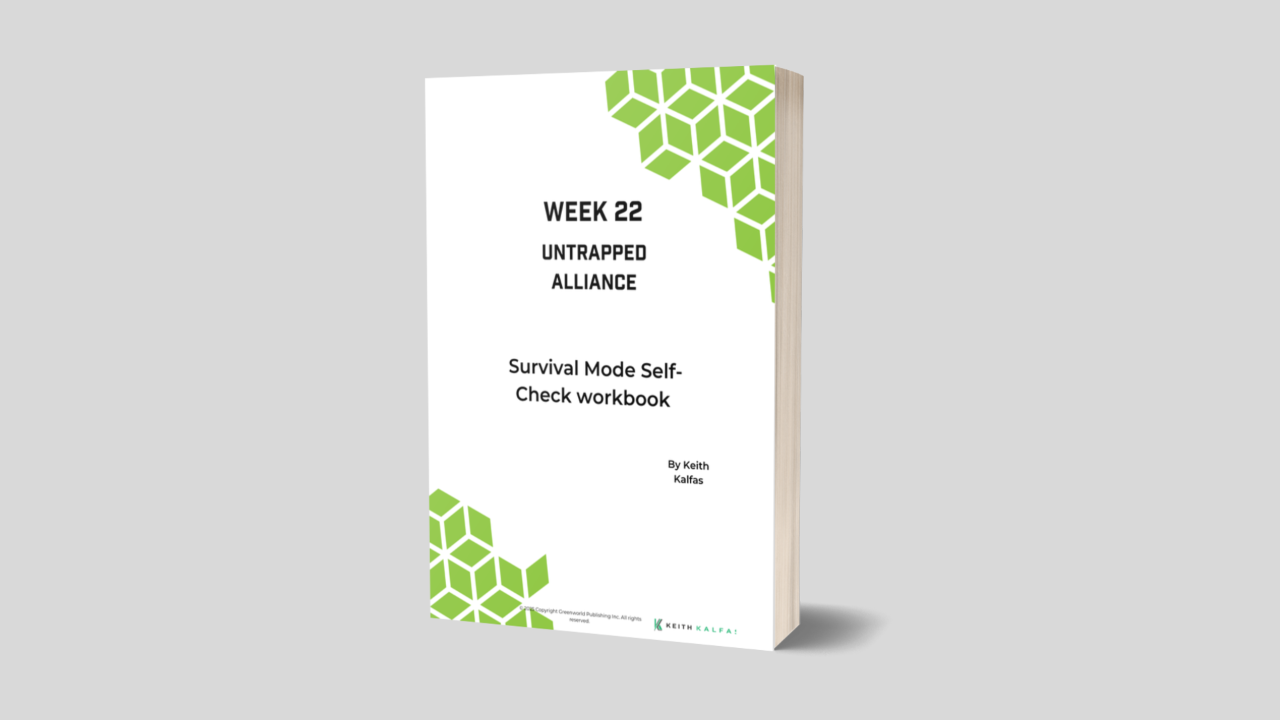
Along with the replay, members get a Survival Mode Self-Check workbook designed to help them slow down, identify the signs, reflect on their own stress patterns, and start recognizing what protection mode looks like in their body, mind, and everyday behavior.
It’s practical. It’s reflective. And it gives you a place to actually process the session instead of just listening to it and moving on.
One Simple Tool Keith Shared
Without giving too much away, one simple thing Keith walked members through in the training was breathing.
Not as a performance trick.
Not as a trendy wellness concept.
Just as a real, usable tool.
Because your breath communicates with your nervous system.
When breathing stays shallow, rushed, and tight, the body keeps reading that signal.
But when you slow it down — even for a few moments — you can begin interrupting the stress response and send a different message.
That’s one of the reasons this call is worth experiencing in full instead of just reading about it secondhand.
It’s not just the information.
It’s the way Keith walks through it.
The way he explains it.
The way it connects to real life.
The way it lands.
And that’s really the value of these Alliance calls in general.
Why This Conversation Matters for Business Owners
A lot of business owners are trying to make better decisions while their internal state is chaotic.
They’re quoting jobs while stressed.
Leading teams while tense.
Handling conflict while emotionally overloaded.
Trying to grow while secretly exhausted.
Trying to create a better future while their body still feels like it’s under attack.
That affects everything.
It affects how you communicate.
How you sell.
How you react.
How patient you are.
How clearly you think.
How you handle setbacks.
How much peace you actually experience while building what you say you want.
If your baseline is tension, your results will eventually reflect that.
That doesn’t mean you can’t succeed while stressed. Plenty of people do.
But it does raise a better question:
What would it look like to build success without destroying your nervous system in the process?
That’s the kind of question Keith is willing to go into.
And the truth is, most people don’t have enough conversations like this.
They get business advice.
They get marketing advice.
They get strategy advice.
But they don’t often get invited to look at the internal state they’re bringing into all of it.
That’s one of the reasons Untrapped Alliance is different.
More Than a Training Library
Untrapped Alliance isn’t just a place to consume information.
It’s a place to keep growing as a person while you build your business and your life.
Keith hosts these calls every other Wednesday, and each one gives members a chance to go deeper into topics that actually matter — not just surface-level tactics, but the real stuff underneath what keeps people stuck.
Sometimes that means business.
Sometimes it means mindset.
Sometimes it means emotional patterns, decision-making, leadership, identity, or personal breakthroughs.
And sometimes, like this session, it means slowing down long enough to recognize that what you thought was a productivity problem may actually be a nervous system problem.
That kind of awareness can change a lot.
And the best part is, if you’re a member, you’re not only getting access to the live calls — you’re also getting the replay library, supporting resources, and session workbooks that help you implement what you’re hearing.
So instead of just listening and nodding along, you have something concrete to work through.
If This Resonates, Don’t Stop at the Blog Post
If any of this sounds familiar — if you’ve felt tense, reactive, exhausted, overstimulated, or like your body just won’t let you fully settle — don’t stop here.
This blog post is only a glimpse.
The full session goes much deeper.
Inside the replay, Keith unpacks the patterns, the internal signals, the protective responses, and the practical shifts in a way that’s hard to capture in a summary. And with the workbook included, you’ll have a way to actually sit with what’s coming up and begin applying it.
If you’ve been needing more clarity, more groundedness, and more honest conversations like this, it may be time to join us inside Untrapped Alliance.
Keith hosts these calls every other Wednesday, and they’re built for people who want more than hype.
They’re for people who want to think clearly.
Grow honestly.
Get unstuck.
And build a life and business from a better place.
If that sounds like what you need, join Untrapped Alliance and come be part of the next call.
You’ll get access to sessions like this one, the workbook downloads, and a growing library of conversations designed to help you get more untrapped in every area that matters.
